What it is
1-bit bridge is a small Go server you run on a Mac, Windows PC, Linux box, or Raspberry Pi alongside your music library. It serves the iOS app over HTTPS instead of SMB — same files, same bit-exact audio, but a transport designed for the app rather than a decades-old file-sharing protocol.
It's free to self-host, and the full source is public under the FSL-1.1-MIT license — every release automatically becomes MIT-licensed two years after it ships. The code, binaries, wire protocol, and release notes live on GitHub; everything you need to install, pair, and run it is documented right here.
The setup walkthrough takes you from a blank machine to a paired iPhone in about ten minutes. Hit a snag? The troubleshooting page is symptom-to-fix.
Why use it instead of SMB
- Faster. A pre-indexed library manifest replaces the iOS app's two-phase SMB scan. The first sync finishes in seconds, not minutes.
- Reachable remotely. SMB is a LAN protocol. The bridge speaks HTTP/2 over TLS — Tailscale, WireGuard, or any direct route works without extra plumbing.
- Easier to set up. Run the installer, approve the device on the admin console, you're paired. No share permissions, no Samba quirks.
- Same audio path. The bridge ships bytes; the iOS app still owns DSD, DoP, gapless, and everything else. No server-side transcoding, ever.
What's new in 0.2.3
Released 5 November 2026. The bridge's own player seeks within a track and plays 16-bit files on more DACs, a disk that mounts late is no longer taken for an empty one, and an update checks your settings before it swaps anything. The iOS wire protocol stays at v1 and every change is additive, so no re-pairing is required:
- Seeking on the bridge's own player. Drag the progress bar in 1-bit, and the player carries on from there.
- 16-bit files on a DAC with no 16-bit format. On a DAC such as the Mytek Brooklyn DAC+, these used to be refused with “couldn't play this track”. The samples now go losslessly in a wider container: no value changes, and a DAC that takes 16-bit sees no difference.
- A player that says what's wrong. When it can't open the DAC, it names the audio group to
fix, and
bridge doctorgives the commands. An OpenHome port clash no longer hides a settings error. - Host names that aren't ASCII.
bridge initandbridge serveused to fail on such a host with “cannot be encoded as an IA5String”, which should reach Windows computer names in Cyrillic or Chinese too. The certificate and the advertised names now use the name's IDNA form, and a name with no valid form pairs at a LAN address. An ASCII name changes nothing. - A disk that mounts late. A disk that mounts after the bridge starts is never taken for an
empty library or data directory. The library's rows are kept, the watcher holds the root and looks again,
and the bridge refuses a recorded data directory that has gone rather than make a new identity and database
on the bare mount point. It also refuses a data directory it can't prepare, and
bridge doctorchecks the data directory for every config. - Safer updates. An update's settings are checked before the swap: a version that refuses
your
bridge.yamlisn't installed, and the console names the line. An install an older updater made rolls back at its first start if it refuses the settings, before the bridge writes anything. A late first boot completes its install, the console offers Roll back only where the rollback would run, and a failed Check now keeps the Updates rows. - DLNA on private addresses only. A public address beside a private one on a LAN interface is
no longer announced or served. To serve one anyway, name it in
dlna.listenAddress; your library is then reachable without a token from wherever that address routes. - The pairing link is
onebit://pair. iOS 27 hands abridge://link to Apple's Watch app, so the console's QR code, scanned with the Camera, didn't reach 1-bit. 1-bit reads the new link from version 2.2; an older app pairs through the three fields by hand.
Before you update:
-
The bridge writes a small record,
.bridge.yaml.datadir, beside its config at the first start with the data directory's volume there. If you move a data directory on purpose, changedataDirin the config, and the record follows it. - If that first start after updating happens while the volume is away, there's no record yet, so it can't be told from a new install. Start with the volume mounted.
The full list is in the 0.2.3 release notes.
What's new in 0.2.2
Released 1 November 2026. A bridge can now tell the app about the player and DAC on its box, and can play through a DAC itself on Linux. Favorites and playlists stay in step across your devices, and your library's playlist files reach the app. The iOS wire protocol stays at v1 and every change is additive, so no re-pairing is required:
- A one-line installer for Linux.
curl -fsSL https://1-bit.swiss/install.sh | shinstalls the bridge on moOde, Raspberry Pi OS, Volumio, Debian or Ubuntu (64-bit, amd64 or arm64) as your own user's service. The script is stamped with its release, installs that release and checks it against the release's checksums; run it again later and it upgrades throughbridge update. - The player beside the bridge. On a Linux box that runs MPD, on its own or under Volumio or moOde, the bridge tells the app about the player, its DAC and the format reaching it, and the console shows a Player / DAC / Music / Phone checklist.
- The bridge's own player. Optional playback on Linux through a USB DAC, with OpenHome control on the LAN. It plays FLAC, WAV, AIFF and ALAC as stereo integer PCM at 16, 24 or 32 bits, at the file's own rate and bit depth when the DAC takes them; floating-point files, 20-bit files and 32-bit FLAC are refused (32-bit WAV, AIFF and ALAC play). In 0.2.2 it is PCM only: a DSD track is refused, never converted, and DSD on this player comes in a later version. The console's Player page shows its status, turns it on or off and chooses its DAC, and a switch there lets the 1-bit app cast to it. Casting to it needs 1-bit 2.2 or later. The player guide walks through it.
- Favorites and playlists in step. Revisions protect newer edits, and change notices tell the app when to refresh. With an app that saves by revision, a heart removed on one device stays removed on the others; 1-bit 2.1 saves the older way, which only adds.
- Playlist files. The bridge reads the
.m3uand.m3u8files in your library for the app, and the console can also export playlists with library-relative paths. - Less repetition in discovery mixes. They leave out tracks already offered in the last seven days, as long as enough others remain.
- Tighter DLNA access. The DLNA listener answers only on this machine's loopback and eligible LAN interfaces' private, link-local or advertised public addresses. Tailscale-only interfaces are excluded; routes to a served address still need your firewall's protection.
Before you update:
- Whole numbers in
bridge.yamlare read strictly. A fraction (2.75) or a leading zero (08080) in a whole-number setting stops the bridge from starting, andbridge doctornames the line; insideoutput.player, such a value turns the player off instead and leaves the bridge running.bridge initwrites neither, but check a file you edited by hand: the updater can't roll back a config that doesn't load. - The first start re-reads every track's tags once.
-
To go back to 0.2.1, remove the
outputblock frombridge.yamlfirst: 0.2.1 refuses keys it doesn't know. -
On a Linux box running MPD,
output.mpdturns on by itself and serves tracks to that MPD on loopback port 7791 without a token, like the DLNA listener;output.mpd: offturns it off. - For the bridge's own player, stop Volumio's or moOde's own playback on that DAC first, since the player opens it exclusively, and restart the bridge after a change on the Player page: it decides its player when it starts.
-
backup.intervalHours: 0now means no automatic snapshots at all, the startup one included;bridge backupstill takes one. -
In Docker, give the container a fixed hostname and set
BRIDGE_CUSTOM_ENDPOINTSto the address your phone dials — see the Docker guide.
The full list is in the 0.2.2 release notes.
What's new in 0.2.1
A hardening release (1 October 2026), much of it from an external security review of the bridge and the app. The iOS wire protocol stays at v1 and every change is additive, so no re-pairing and no app update are required, and the bit-exact audio path is untouched:
- Pairing links carry a one-time code. The console's QR code and link used to carry the device's long-lived token, so anyone who saw the link held the credential. The app now trades a single-use, ten-minute code for a fresh token, and the link stops working at that moment.
- Sign every console session out from the Devices page, or with
bridge admin sign-out-everywhere; a password reset signs everyone out by default. - Quieter logs. The web server's lines about a failed connection keep no client address, an error the app can receive names library files by their library-relative path, and no log line prints a credential written into a configured URL.
- More of your tags, read right. A FLAC or Ogg date the tag reader can't parse no longer reaches your devices as year 1, every PCM container reports its duration, M4A keeps its genre and freeform tags, and the compilation flag reaches the app (1-bit 2.1 files a flagged album that has no album artist under Various Artists). The first scan after the update re-reads your library once.
- DSD renditions keep an album's balance. The level boost that brings DSD up to PCM level is decided per album, so its tracks keep the differences they were mastered with, and renditions survive moving the library to a new host or path.
- A restart from the console relaunches the bridge on macOS and Windows. Updating
from 0.2.0 through the console on those two? Run
bridge restartonce afterwards.
The full list is in the 0.2.1 release notes.
What's new in 0.2.0
Since 0.1.9. The iOS wire protocol stays at v1 — everything below is additive, so older app builds keep working unchanged, no re-pairing and no app update are required, and the bit-exact audio path is untouched:
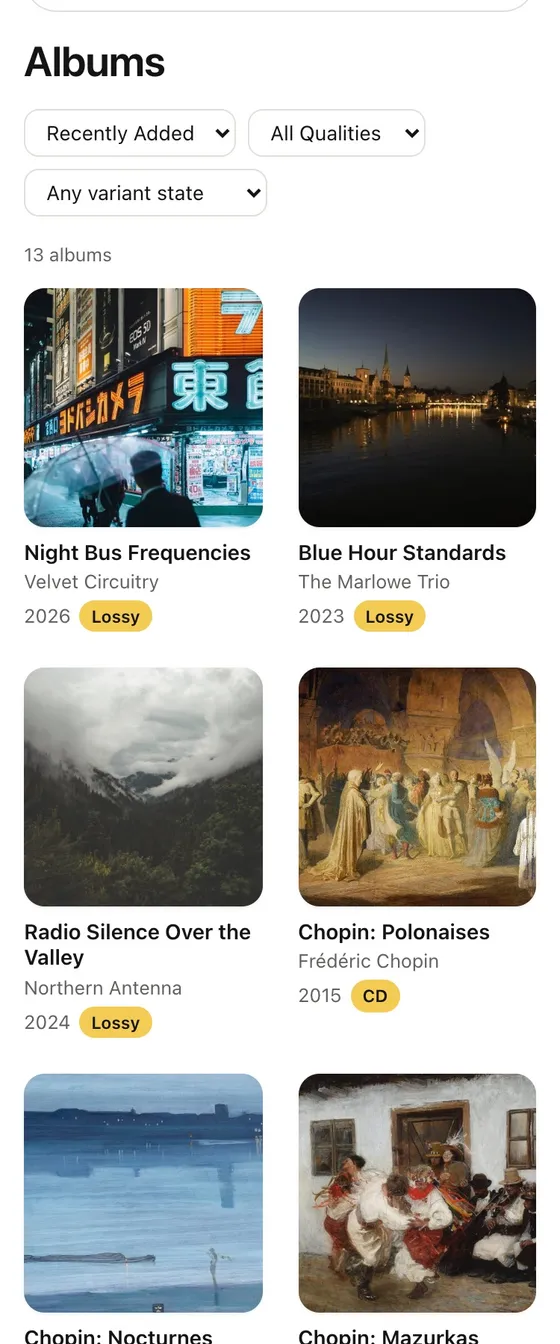
- The console is now a player. Albums with an A–Z rail, artists with portraits, genres, composers, playlists and Smart Mixes as real player pages, and a now-playing bar that survives navigation to the operator pages — the same web player on your laptop as on your phone. The Albums page opens at once: its coverage badges come from a snapshot that refreshes behind the request rather than from two library scans in front of it.
- Add music from the browser. Chunked, resumable, content-verified uploads — files or whole folders — behind their own switch, and a separate delete-as-trash switch that moves files into a dated trash folder inside your library instead of unlinking them. The only way to fill a library on a host you have no shell on.
- DSD → PCM renditions. For a wired DAC that can't take a DSD rate, the bridge renders a DSD source offline into a faithful 176.4 / 192 kHz 24-bit tier and a compact tier, and serves them beside the untouched original. Measured, not assumed: a −116.8 dB decimation stopband, a +0.00 dB alias differential on the faithful tier, a rendition landing at −0.97 dBTP against its −1.0 target — and the measurements run in CI on every change.
- Lyrics, one document per track. The bridge extracts,
stores and serves lyrics from ID3, Vorbis and MP4 tags and from
.lrc/.ttml/.txtsidecars, in the order the app already uses, and an opt-in network tier fills the gaps from a self-hosted Atlas relaying LRCLIB. A transcript with one time cue is plain text, not a synced stub — the same rule the app applies. - Covers reach every screen. DLNA renderers finally get album art from the
LAN listener; SACD ISO images expand into virtual tracks; ALAC
can be upscaled;
GET /v1/searchputs the library's search index on the wire; artist portraits are content-keyed and cache forever. - For operators. One-time console login
links that survive a phone-to-laptop hand-off, a hosted-tenant posture that hides and
refuses what a tenant doesn't own, an export of everything a
person made, database compaction and history retention windows, per-route rate limits,
/healthz+/readyz, and settings that apply on save — with the response saying, per field, what actually took effect. - Under the hood. 175 pull requests — four review sweeps, 39 fuzz targets across ten packages fuzzed nightly, the Windows and macOS test legs promoted into the merge gate — and the first release under FSL-1.1-MIT: v0.1.9 and earlier stay MIT, and each release converts to MIT two years after it ships. Self-hosting is free and the source is public, as before.
Full release notes and upgrade guidance: github.com/acoseac/1-bit-bridge/releases.
Bit-exact, by design
When it serves the app, the bridge never decodes, resamples, or transcodes the source files. It serves the bytes the iOS app asks for — DSF, DFF, FLAC, ALAC, WAV, AIFF, MP3, AAC — and the iOS app does the rest. The full DSD pre-cache that protects DoP marker alignment still applies; the bridge just gets the bytes there faster. Optional upscaled variants are generated alongside the originals, never in place of them.
The bridge's own player, on Linux, plays rather than serves: it decodes stereo FLAC, WAV, AIFF and ALAC files of 16, 24 or 32 integer bits to PCM for its DAC, at the file's own rate and bit depth, with no resampling; a 32-bit FLAC (32-bit WAV, AIFF and ALAC play) or a file the DAC can't take is refused. On a DAC with no 16-bit format, a 16-bit file goes in a wider container with no value changed.